
ZM310: The Next Generation of Corrosion Protection in Cable Containment
How zinc-aluminium-magnesium coated steel is challenging traditional hot-dip galvanising and changing the way industrial cable management systems are specified.
For decades, hot-dip galvanised steel has been one of the principal choices for protecting industrial cable containment systems against corrosion. From wastewater treatment works and petrochemical installations to energy infrastructure and commercial developments, engineers have relied on zinc coatings to protect steel cable tray, cable ladder, trunking and support systems.
However, developments in metallic coating technology are challenging established specifications.
Zinc-aluminium-magnesium coated steel, particularly ZM310, represents a significant advancement in corrosion protection. By combining an engineered alloy coating with a more efficient manufacturing process, it offers an increasingly compelling alternative to traditional post-fabrication hot-dip galvanised (HDG) steel.
For designers, contractors and asset owners, this is not simply a change in surface finish. It offers the opportunity to reconsider durability, installation efficiency, maintenance requirements and whole-life project costs.
At R&M Distribution in Kirkcaldy, we recognise the importance of these developments. With stockholding and supply capabilities across Unitrunk, Vantrunk and Armorduct cable containment products, we are supporting the adoption of advanced metallic finishes across Fife and Central Scotland.
What Exactly Is ZM310?
ZM310 is a zinc-aluminium-magnesium alloy coating designation covered by BS EN 10346, the standard governing continuously hot-dip coated steel flat products.
Unlike conventional batch hot-dip galvanising, where a fabricated steel component is immersed in molten zinc after manufacture, ZM-coated steel is produced by applying the metallic alloy coating continuously to steel strip before the material is formed into its finished profile.
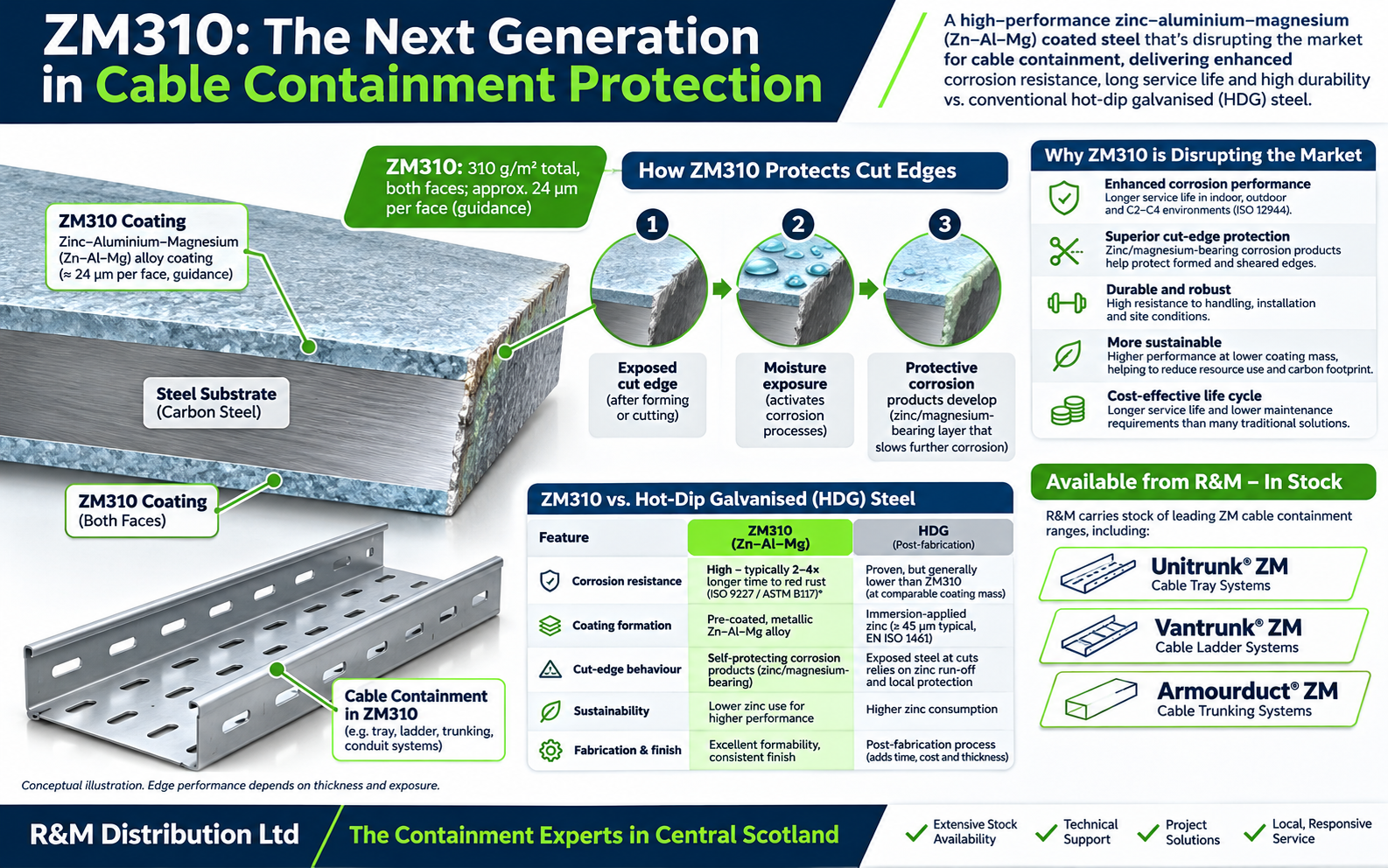
The designation ZM310 identifies a minimum total coating mass of 310 g/m² across both surfaces, determined using the three-spot test specified by the relevant coating standard.
The nominal coating corresponds to a typical thickness of approximately 24 µm per face, although actual values depend on the coating specification, distribution and manufacturing tolerances.
One well-established example is ArcelorMittal’s Magnelis®, which uses a nominal alloy composition of:
- 93.5% zinc
- 3.5% aluminium
- 3% magnesium
These alloy proportions are specific to Magnelis and should not be assumed for every proprietary ZM coating.
The coating’s performance derives from more than its thickness. Its chemical composition influences the formation, stability and protective properties of the corrosion products that develop during environmental exposure.
Figure 1: ZM310 steel cross-section
The Science Behind ZM310’s Corrosion Resistance
The protection provided by ZM310 combines sacrificial corrosion protection with the formation of relatively stable surface corrosion products.
Sacrificial protection
Zinc is electrochemically more active than carbon steel. In the presence of a suitable electrolyte, such as condensed moisture containing dissolved salts, zinc preferentially corrodes and can provide sacrificial protection to exposed steel.
This is the same fundamental principle used in conventional zinc galvanising.
However, ZM coatings introduce additional corrosion-control mechanisms through the inclusion of magnesium and aluminium.
Formation of a protective surface film
When exposed to moisture and atmospheric contaminants, the zinc-aluminium-magnesium coating develops corrosion products that can form a comparatively compact and stable protective layer.
Magnesium influences the formation and stability of these products, helping reduce the progression of corrosion under suitable environmental conditions.
The effectiveness of this mechanism varies with chloride concentration, humidity, wetting and drying cycles, temperature and the specific alloy formulation.
Protection at cut edges
One of the most commercially important properties of zinc-magnesium coatings is their potential to provide enhanced protection at exposed cut edges and perforations.
Where a ZM-coated sheet is cut, the underlying carbon steel may become exposed because the original coating was applied before fabrication.
During subsequent environmental exposure, zinc- and magnesium-containing corrosion products can develop across parts of the exposed edge, reducing the rate of further corrosion.
This effect is frequently described as self-healing.
It is important to understand that the coating does not regenerate as a fresh metallic layer. Instead, corrosion products originating from the adjacent coating can provide additional protection to exposed steel.
The effectiveness of this process depends on coating thickness, steel gauge, edge geometry and environmental conditions.
ZM310 Versus Hot-Dip Galvanised Steel: A Technical Comparison
Conventional post-fabrication hot-dip galvanising remains a proven and highly effective corrosion protection process.
The key distinction is that conventional HDG relies substantially on a relatively thick zinc coating applied to the completed component, whereas ZM310 uses a thinner engineered alloy coating with different corrosion behaviour.
| Technical consideration | ZM310 | Post-fabrication HDG |
|---|---|---|
| Coating material | Zinc-aluminium-magnesium alloy | Predominantly zinc |
| Application process | Continuous coating of steel strip before fabrication | Immersion of the finished component |
| Coating thickness | Approximately 24 µm per face, typically | Varies with material thickness and BS EN ISO 1461 requirements |
| Cut-edge behaviour | Corrosion products can provide additional protection under suitable conditions | Fabricated edges are coated during galvanising; subsequent site cuts require assessment |
| Surface appearance | Generally uniform metallic finish | Characteristic galvanised finish, varying with the process |
| Manufacturing | Can eliminate a separate post-fabrication galvanising operation | Requires processing after fabrication |
| Project considerations | Potential lead-time, handling and lifecycle advantages | Established performance, extensive experience and broad specification acceptance |
A coating thickness comparison alone does not establish corrosion performance. The chemistry, exposure environment, product geometry and quality of application must also be considered.
Under BS EN ISO 1461:2022, for example, the minimum mean coating thickness for typical non-centrifuged fabricated steel articles is 55 µm where the steel thickness is greater than 1.5 mm and up to 3 mm. Thicker steel sections generally require higher mean coating thicknesses.
ZM310 and conventional HDG must therefore be compared on the basis of verified performance under relevant conditions, rather than simply assuming that the thicker coating will always perform better.
Independent Research Is Changing the Specification Debate
A particularly significant development occurred in June 2026 when the Steel Construction Institute (SCI) issued report RT2087, reviewing the corrosion protection performance of ArcelorMittal Magnelis ZM310 and ZM430 against batch galvanised coatings manufactured in accordance with ISO 1461.
For the environments considered within the supporting research, SCI concluded that:
The expected design life of Magnelis ZM310 was greater than that of a 55 µm batch-galvanised coating.
The review also found that the corrosion products associated with Magnelis can generally provide enhanced protection at unprotected cut edges compared with conventional zinc galvanising.
These conclusions are significant because they provide technical support for considering ZM310 in applications where post-fabrication galvanised products might otherwise have been selected automatically.
However, the report includes important qualifications.
SCI identified that effective cut-edge protection depended on the Magnelis coating thickness exceeding 20 µm and the ratio of steel thickness to coating thickness not exceeding 60, for the conditions assessed.
For illustration, a 2 mm thick steel component with a coating thickness of 24 µm gives a ratio of approximately 83. This exceeds the ratio identified in the report and demonstrates why cut-edge performance must not be assumed for every containment gauge or fabrication detail.
The report was commissioned by ArcelorMittal and involved an independent engineering review of research information supplied to SCI, rather than a separate programme of laboratory testing conducted by SCI itself.
It did not establish universal equivalence for every environment, finished component or cable management system.
For responsible specification, the conclusion is clear: ZM310 has credible evidence supporting its use as an alternative to HDG in suitable applications, but manufacturer-specific technical evidence and project conditions remain essential.
Why ZM310 Is Disrupting the Cable Containment Market
1. Challenging traditional material specifications
For many years, heavy-duty industrial containment specifications have defaulted to post-fabrication hot-dip galvanising.
ZM310 introduces an alternative supported by developments in coating technology and increasingly substantial corrosion performance evidence.
This creates opportunities for engineers to reassess standard material schedules without automatically accepting the cost, weight of coating or processing requirements associated with traditional finishes.
2. Improving manufacturing and delivery efficiency
Conventional HDG containment often requires finished steel components to undergo an additional external galvanising operation.
This introduces further handling, transportation and manufacturing stages.
Because ZM-coated steel is supplied ready for subsequent forming, manufacturers may eliminate that additional process.
Unitrunk has specifically highlighted this advantage when expanding its ZM cable tray and Speedway cable ladder ranges.
For projects working to demanding construction programmes, reducing manufacturing stages can translate into shorter lead times and improved supply flexibility.
Actual lead times will, of course, depend on the selected product, manufacturing capacity and stock availability.
3. Supporting lower-impact construction
Steel production and corrosion protection both contribute to the environmental impact of cable containment systems.
Where a suitable ZM coating achieves the required durability with a lower coating mass and fewer post-fabrication processes, it may offer environmental advantages.
Potential benefits include reduced additional processing, fewer transport movements and reduced maintenance or replacement requirements over the asset’s service life.
However, lower carbon emissions cannot be assumed solely because a component uses ZM310.
Environmental Product Declarations (EPDs), manufacturer lifecycle assessments and comparable product data should be used to establish the actual environmental performance of a proposed system.
4. Improving whole-life value
The lowest purchase price does not necessarily represent the lowest project cost.
Containment installed above operational machinery, within treatment works, in energy infrastructure or across inaccessible service routes may involve substantial labour and operational disruption if replacement becomes necessary.
Where ZM310 offers the required corrosion protection and reduces maintenance interventions, the benefits may extend well beyond the original purchase cost.
A meaningful comparison should consider:
- Initial material and installation cost
- Expected corrosion exposure and service life
- Maintenance and inspection requirements
- Replacement costs and operational disruption
- Environmental performance over the asset lifecycle
This is where ZM310 has the potential to alter established procurement decisions.
Where Can ZM310 Deliver the Greatest Benefits?
ZM310 is particularly relevant where installations require a more corrosion-resistant finish than conventional pre-galvanised zinc coating, but where stainless steel or post-fabrication HDG has traditionally been selected.
Water and wastewater infrastructure
Water treatment works and wastewater facilities can expose containment systems to humidity, condensation, chlorides, chemical vapours and changing atmospheric conditions.
ZM310 may provide a valuable alternative for suitable cable tray, ladder and support applications where a robust corrosion protection strategy is required.
For Scottish Water and other water-sector projects, the chosen system must still satisfy the applicable client specifications, installation requirements and any relevant WIMES provisions. The coating designation alone does not establish product approval.
Energy and industrial infrastructure
Industrial processing facilities, energy installations and external plant areas often combine complex cable routing with demanding environmental conditions.
The availability of ZM-coated containment allows designers to consider alternatives to conventional galvanised systems while maintaining attention to load capacity, electrical continuity and environmental exposure.
Data centres and critical infrastructure
Large data centre developments require extensive containment networks, predictable installation programmes and reliable long-term performance.
ZM products may be particularly relevant for exposed service routes, roof-mounted plant and other locations where additional corrosion resistance is justified.
Indoor containment selection should remain proportionate to the actual exposure conditions and project requirements.
Food and beverage manufacturing
Food production sites frequently involve high humidity, condensation, cleaning operations and temperature variation.
ZM310 may offer advantages in suitable process areas, although chemical compatibility must be checked carefully.
Aggressive washdown regimes, direct chemical exposure and hygiene requirements may still justify stainless steel or another specialist finish.
Coastal and marine-related installations
Zinc-magnesium systems can perform well in certain chloride-rich atmospheres, making them worthy of consideration for coastal infrastructure.
However, direct seawater exposure, persistent salt accumulation, chemical contamination and highly aggressive marine conditions require detailed assessment.
ZM310 should not be presented as a universal replacement for stainless steel or specialist offshore corrosion protection systems.
R&M Distribution: The Cable Containment Experts in Central Scotland
Selecting the correct containment system is about more than choosing between galvanised and zinc-magnesium steel.
Engineers and contractors must also consider mechanical loading, support centres, deflection, cable weight, installation geometry, corrosion classification, electrical continuity and compatibility between system components.
That is where R&M Distribution delivers value.
Based in Kirkcaldy, Fife, R&M is an independent, employee-owned electrical distributor with extensive experience supplying industrial and commercial electrical infrastructure.
We carry stock across the cable containment portfolios of Unitrunk, Vantrunk and Armorduct, including ZM products and associated containment solutions.
Our manufacturer relationships enable us to support contractors and project engineers in identifying suitable tray, ladder, trunking, channel and accessories for industrial and commercial installations.
Unitrunk provides an expanding range of ZM cable management solutions, including cable tray and Speedway cable ladder systems.
Vantrunk brings specialist expertise in engineered cable management systems for the energy, oil and gas, and industrial processing sectors. R&M can advise on the appropriate product range, material finish and availability against individual project requirements.
Armorduct offers cable containment manufactured using ArcelorMittal Magnelis technology, including ZM310-based solutions for demanding installations.
Rather than simply supplying a catalogue part number, our approach is to understand the installation and identify the most appropriate technical and commercial solution.
From equipment schedules and cable containment layouts to alternative specifications, material selection, project stockholding and phased supply, we aim to provide practical support throughout the procurement process.
With established customer relationships across industrial manufacturing, energy, water infrastructure and commercial engineering, R&M is well placed to support the growing demand for advanced cable containment across Fife, Edinburgh, Glasgow and the wider Central Belt.
What Should Engineers Check Before Specifying ZM310?
Before substituting a traditional HDG containment system with ZM310, the following considerations should form part of the technical assessment.
Environmental exposure: Establish the relevant atmospheric corrosivity category using BS EN ISO 9223 and consider local influences such as chlorides, condensation, cleaning chemicals and industrial emissions.
Coating verification: Confirm the actual zinc-aluminium-magnesium coating designation, coating mass and manufacturer technical data.
Cut-edge treatment: Assess material gauge, cutting operations, perforations, welded areas and any manufacturer requirements for localised protection or repairs.
Mechanical performance: Verify the safe working load, support spacing and deflection characteristics of the complete containment system. BS EN 61537 or the applicable current BS EN IEC 61537 adoption provides the relevant framework for cable tray and ladder system testing.
Electrical performance: Confirm electrical continuity, protective bonding arrangements and compliance with the installation design and BS 7671.
System compatibility: Ensure that couplers, brackets, fasteners and supports are suitable for the exposure conditions and do not introduce avoidable galvanic corrosion risks.
Client acceptance: Check that the selected finish is permitted under the project specification and that any necessary technical approval has been obtained.
These considerations apply particularly when substituting systems on established industrial frameworks or projects governed by strict engineering standards.
Conclusion: A Significant Change in How We Specify Cable Management
ZM310 is not simply a different version of galvanised steel.
It represents a shift towards engineered metallic coatings that deliver corrosion resistance through alloy chemistry and controlled protective-film formation, rather than relying exclusively on coating thickness.
The growing availability of ZM-coated cable tray, ladder, trunking and support systems demonstrates that the cable containment industry is responding to changing requirements for durability, manufacturing efficiency and lifecycle value.
The latest research provides compelling reasons for engineers to consider ZM310 as a credible alternative to traditional post-fabrication galvanising in appropriately assessed environments.
Traditional HDG will continue to have an important role, particularly where established specifications, post-fabrication coverage or project conditions favour its use. Equally, stainless steel and specialist materials remain essential for some aggressive environments.
The opportunity is not to replace every conventional finish indiscriminately, but to specify the most appropriate system for the application.
At R&M Distribution, we believe the future of cable management is built on informed specification, reliable stock availability and genuine technical product knowledge.
Whether you are planning a wastewater treatment project, an industrial plant upgrade, an energy installation or a major commercial development, our Kirkcaldy team can assist with the selection and supply of cable containment systems suited to your requirements.
Talk to R&M Distribution
Your Cable Containment Experts in Central Scotland
R&M Distribution Ltd
Unit 1, Carwhinny
Mitchelston Industrial Estate
Kirkcaldy, Fife, KY1 3LS
Telephone: 01592 655565
Email: enquiries@rmdist.com
Website: https://rmdist.com
Technical note: The information in this article is intended as general technical guidance. Material selection, corrosion performance, product approval and design suitability should be verified against current manufacturer documentation and the specific requirements of each project.
Technical References and Sources
1. Steel Construction Institute, June 2026.
Review of Magnelis® Coating Performance as Corrosion Protection Compared to Batch Galvanizing. Report RT2087, Version 02.
https://constructalia.arcelormittal.com/files/Magnelis_SCI_RT2087report_EN–1db80d00b25431295e93ddaabd6f75b8.pdf
2. Steel Construction Institute, RT1999.
Review of Magnelis® Coating – ZM310. Assessment of ZM310 performance as an alternative to Z600 for specified steel construction applications.
https://industry.arcelormittal.com/repository2/fce/transfer/Magnelis_SCI_RT1999report_EN.pdf
3. ArcelorMittal.
Magnelis®: Zinc-Aluminium-Magnesium Metallic Coated Steel. Technical information, alloy composition and corrosion performance.
https://constructalia.arcelormittal.com/en/products/magnelis
4. Unitrunk, 2026.
Unitrunk Extends the Speedway® Ladder Range. ZM coated cable ladder, manufacturing efficiency and corrosion resistance.
https://unitrunk.co.uk/unitrunk-extends-the-speedway-ladder-range/
5. Armorduct Systems Ltd.
Magnelis® ZM310 Cable Containment. Manufacturer technical literature covering coating chemistry, cut-edge protection and applications.
https://www.armorduct.com/wp-content/uploads/2024/06/Armorduct-Magnelis-ZM310.pdf
6. Galvanizers Association.
EN ISO 1461: Hot-Dip Galvanized Coatings on Fabricated Iron and Steel Articles. Coating requirements and inspection methods.
https://galvanizing.org.uk/galvanizing-standards/iso-1461/
7. British Standards Institution.
BS EN 10346: Continuously Hot-Dip Coated Steel Flat Products for Cold Forming. Metallic coating designations and technical delivery conditions.
8. International Electrotechnical Commission.
IEC 61537:2023, Cable Management – Cable Tray Systems and Cable Ladder Systems. Mechanical and electrical system requirements.
https://webstore.iec.ch/en/publication/31963
9. BS EN ISO 9223.
Corrosion of Metals and Alloys – Corrosivity of Atmospheres – Classification, Determination and Estimation.
10. Vantrunk.
Engineered Cable Management and Support Systems. Manufacturer technical and product information.
https://vantrunk.com/
ZM310, zinc magnesium cable tray, zinc magnesium cable management, ZM310 vs hot dip galvanised steel, Unitrunk ZM, Armorduct Magnelis, cable containment Scotland